Research

A Geometric Approach to Directional Time-Varying Graphs
Learning depends on the brain’s ability to generate organized patterns of activity that adapt behavior. To understand dynamic phenomena—learning, cognition, and disease progression—we need to study how neuronal connectivity evolves over time. Connectivity is commonly described at three complementary levels: structural, functional, and effective. Structural connectivity captures the anatomical wiring between neurons. Functional connectivity is typically inferred from correlations in activity and is often informative, but it is inherently undirected and does not establish causality. Effective connectivity, by contrast, describes directed influences—how activity in one neural population shapes activity in another.
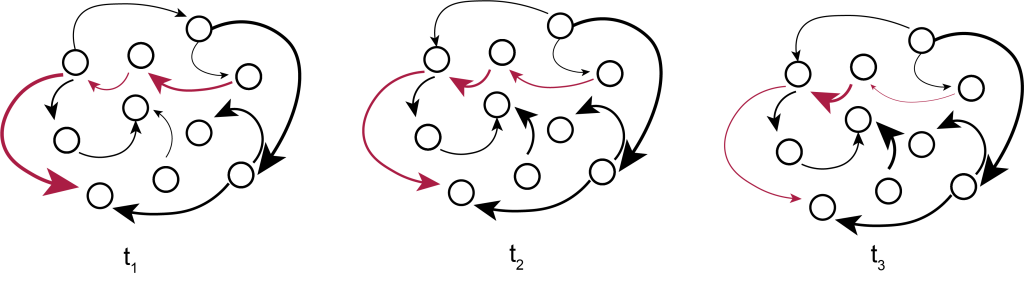
A useful way to formalize these relationships is to represent neural circuits as graphs, with nodes denoting neural units and edges denoting connections. Correlation-based functional graphs are symmetric, whereas effective graphs are directed and explicitly encode influence and directionality.
Directed connectivity models are widely used in fMRI, but the temporal resolution of BOLD signals (on the order of seconds) limits their ability to capture fast learning-related dynamics. Invasive recordings such as calcium imaging and electrophysiology provide population-scale measurements at the timescales of neural computation, making them well suited for studying evolving connectivity. Yet despite growing interest in network dynamics, many analyses in these modalities still rely on undirected measures.
We develop computational methods to infer and analyze large-scale neuronal networks by modeling effective connectivity as a time-varying directed graph. We apply these approaches to ask how circuit interactions reorganize as new representations form. More broadly, our goal is to reveal principles that link synaptic plasticity, circuit dynamics, and behavior during learning and navigation.