
Publications

Group Publications Highlights

An organizing principle for spatial transformation across diverse rooms in the hippocampal formation
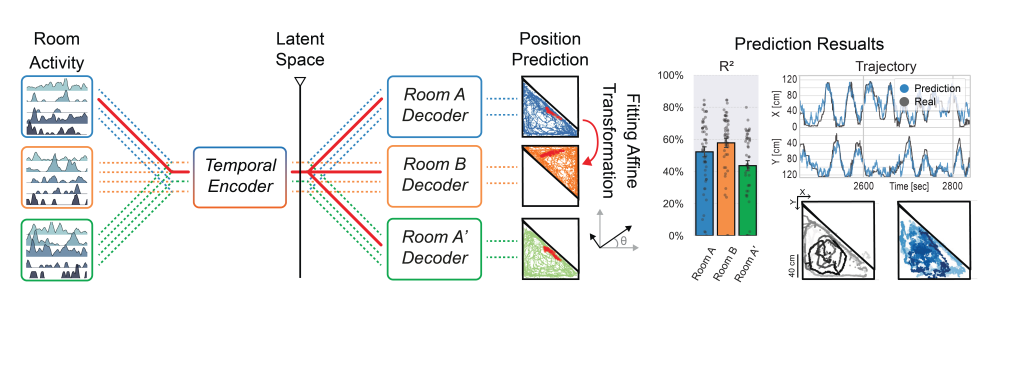
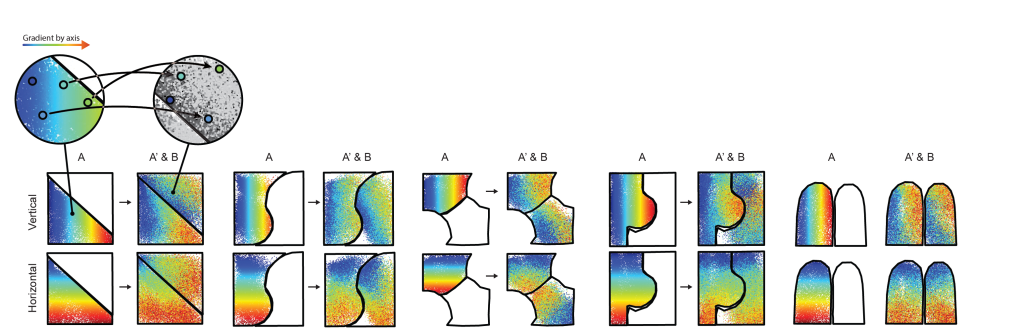
The remapping of spatial firing fields of cells in the hippocampal formation between rooms is a well-known and extensively studied phenomenon; however, the organizing principle for this remapping is unknown. While CA1 shows random remapping, regions such as the subiculum and medial entorhinal cortex (MEC) display a more organized transformation between rooms. Still, the structure of this transformation is unknown. To study this, we used high-density chronic Neuropixels recordings of the subiculum and MEC in freely moving mice and investigated the structure of the transformation at the population level. We implemented an advanced decoder to estimate the existence and characteristics of the remapping transformation. We deliberately designed the decoder as non-linear and time-dependent to capture rich and complex transformations. To our surprise, we discovered that the ensemble activity often underwent a simple, smooth, low-dimensional transformation captured by an affine transformation (i.e., rotation, scaling, and shear). The population code is thus flexibly adapted to a new context while retaining a stable spatial representation at the network level. This principle was reproduced across the subiculum and the MEC, as well as across spatial cell types such as border, head direction, and other spatially modulated cells. These results provide new insights into the computational principles of hippocampal formation remapping, suggesting that spatial cognition is subserved by adaptive ensemble codes governed by a simple affine coordinate transformation. Our findings establish population structure as a critical organizing principle for spatial memory, suggesting avenues for decoding spatial information in unvisited environments by embedding transformation rules into population-level decoders. We thus demonstrate for the first time a simple organizing principle for the representation of the transformation between diverse environments in the hippocampal formation.
(Preprint)

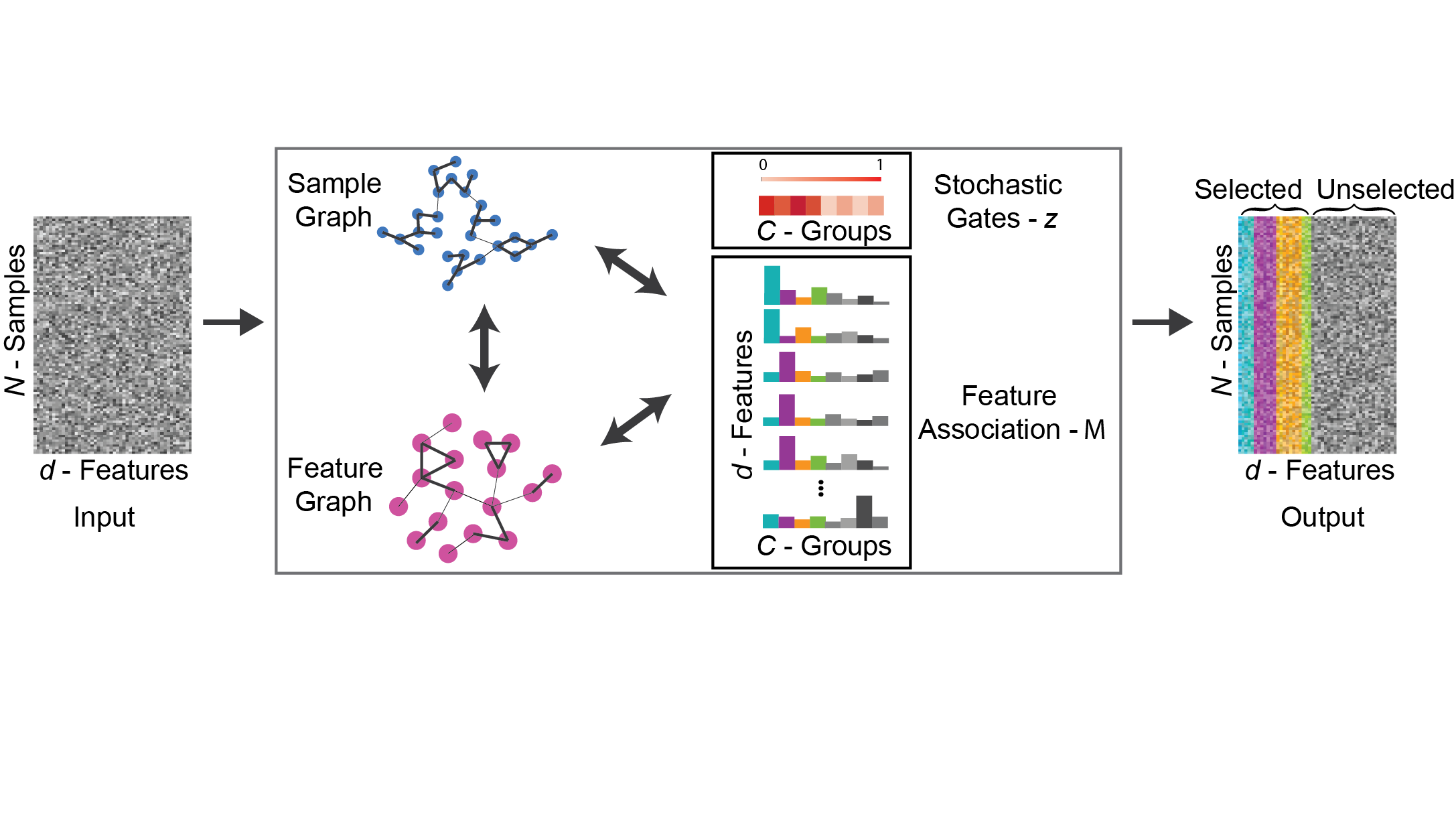
Unsupervised Feature Selection Through Group Discovery
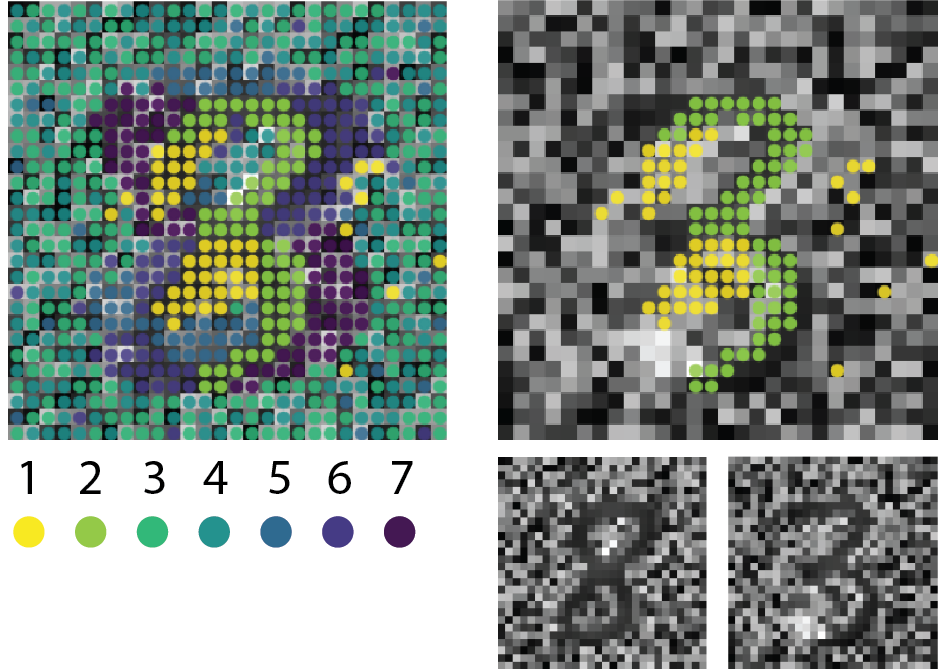
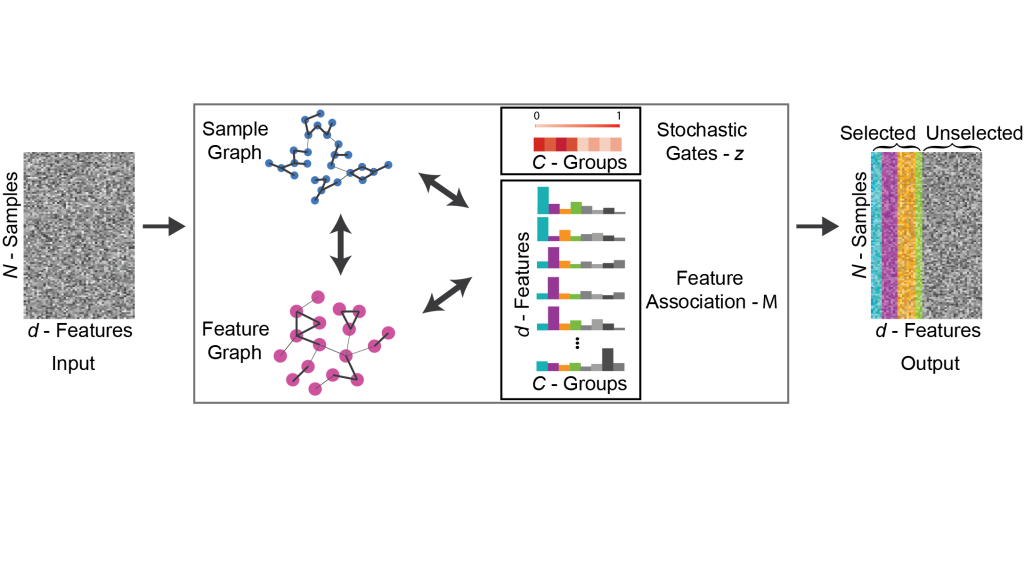
Unsupervised feature selection (FS) is essential for high-dimensional learning tasks where labels are not available. It helps reduce noise, improve generalization, and enhance interpretability. However, most existing unsupervised FS methods evaluate features in isolation, even though informative signals often emerge from groups of related features. For example, adjacent pixels, functionally connected brain regions, or correlated financial indicators tend to act together, making independent evaluation suboptimal. Although some methods attempt to capture group structure, they typically rely on predefined partitions or label supervision, limiting their applicability. We propose GroupFS, an end-to-end, fully differentiable framework that jointly discovers latent feature groups and selects the most informative groups among them, without relying on fixed a priori groups or label supervision. GroupFS enforces Laplacian smoothness on both feature and sample graphs and applies a group sparsity regularizer to learn a compact, structured representation. Across nine benchmarks spanning images, tabular data, and biological datasets, GroupFS consistently outperforms state-of-the-art unsupervised FS in clustering and selects groups of features that align with meaningful patterns.
Shira Lifshitz, Ofir Lindenbaum, Gal Mishne, Ron Meir and Hadas Benisty
(Accepted to AAAI, preprint)

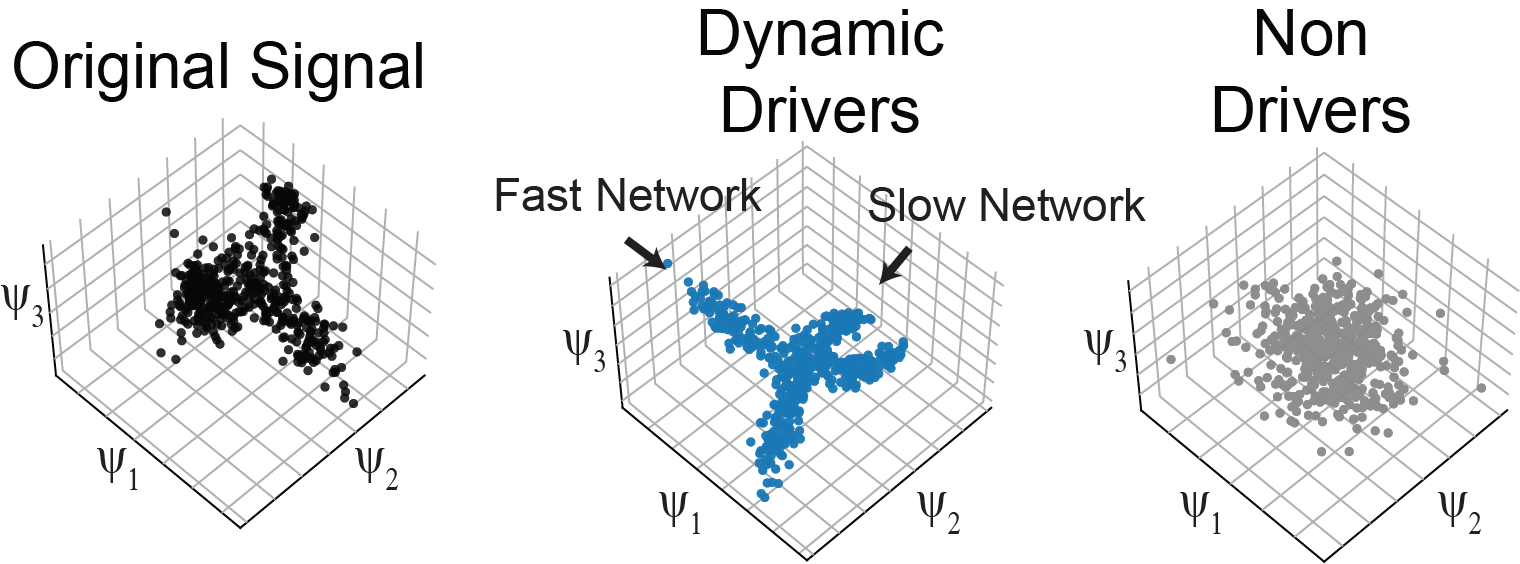
Unraveling Network Dynamics via RONI: Riemannian filtering Of Network Interactions
Understanding how patterns of neural interactions evolve over time is a central challenge in neuroscience. Traditional analyses often focus on how neural activity changes, while assuming that the correlations between neurons or brain regions remain static. Yet, in reality, these interactions are highly dynamic, reflecting ongoing processes such as learning, attention, or adaptation.
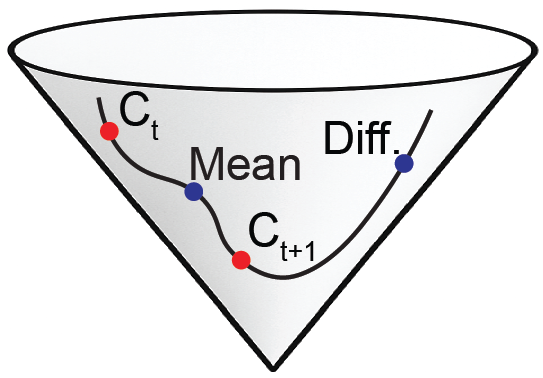
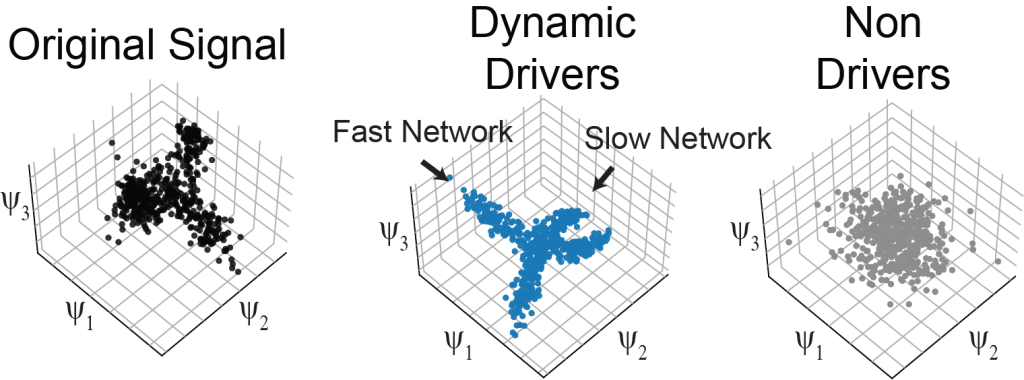
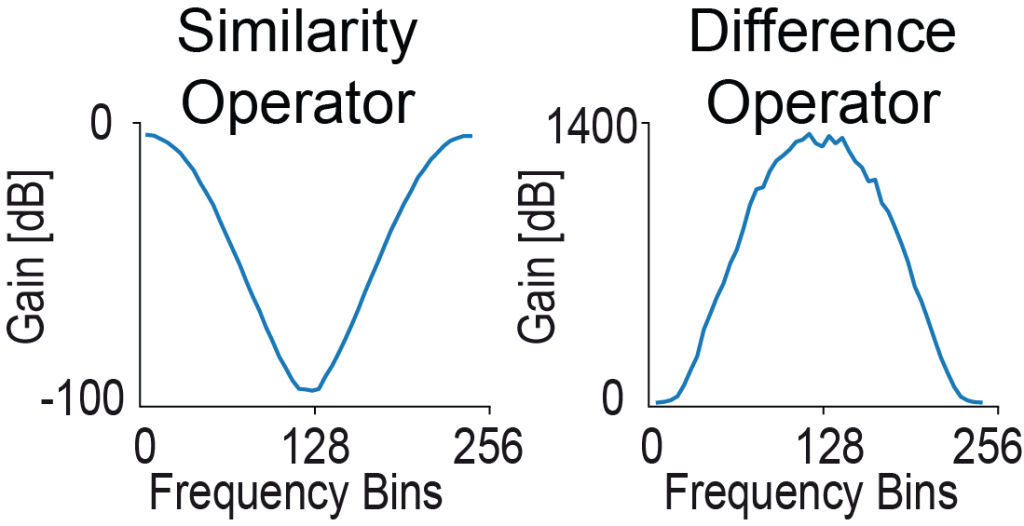
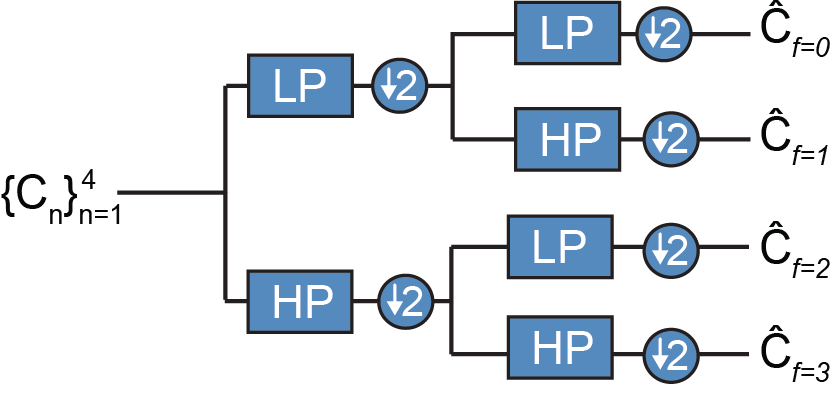
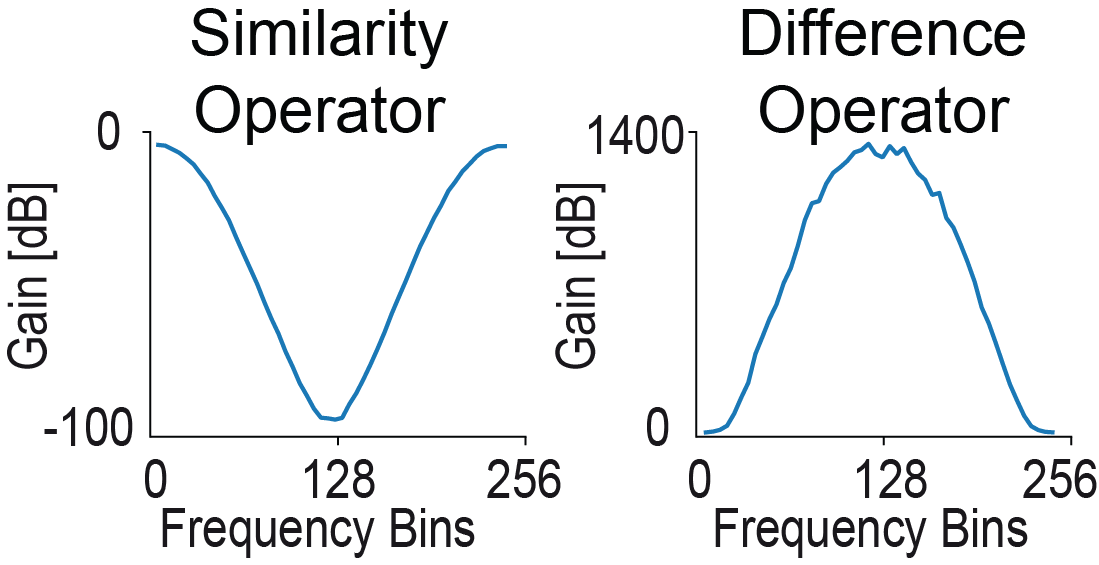
Here, we introduce a new computational framework for examining the temporal dynamics of functional connectivity. Our approach represents each time point as a correlation matrix, capturing how neural elements co-fluctuate, and then analyzes how these matrices change over time using a geometry-aware, multi-resolution method. This framework allows us to separate slow and fast components of network reorganization and to identify specific sub-networks that drive these changes.
We demonstrate the utility of our approach on large-scale population recordings collected via various modalities such as Calcium imaging, electrophysiology and EEG, spanning from local dendritic signals to large-scale cortical networks. Across these diverse systems, our method uncovers meaningful patterns of connectivity dynamics that correspond to behavioral changes and learning-driven reorganization. These results demonstrate our method as a principled and interpretable framework for studying the internal mechanisms of temporal evolution of neural networks.
Yonatan Kleerekoper, Kesem Shapira, Yonatan Keselman, Sandra Nestler, Mohammad Kurtam, Shai Abramson, Dori Derdikman, Yitzhak Schiller, Simon Musall, and Hadas Benisty
(Physical Review Research (PRR), code)

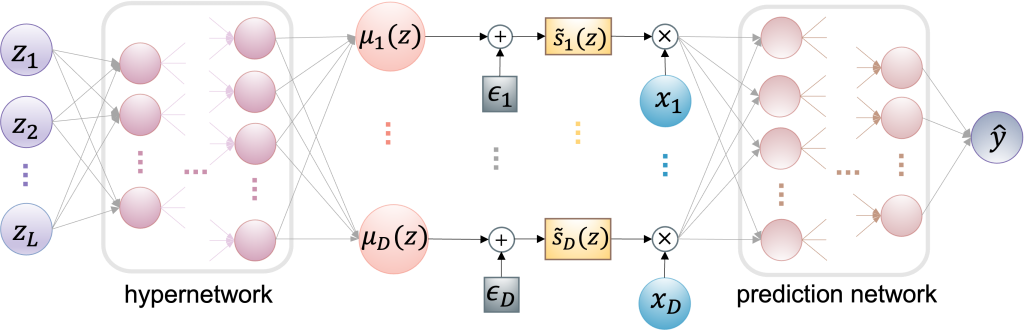
Contextual Feature Selection with Conditional Stochastic Gates
We propose a novel architecture for learning the importance of each input variable for prediction of the target variable(s) as a function of a given context. Our extensive benchmark shows that c-STG improves feature selection, enhances prediction accuracy as well as model interpretability across multiple real-world domains.
All Group Publications
-
Spatial remapping in the subicular complex and entorhinal cortex follows low-dimensional geometric principles
-
Geometric mode-selection scores for delay-coordinates dynamic mode decomposition
Y. Harris, H. Benisty, R. Talmon
Chaos, 2026 (code(opens in new tab)).
-
Unraveling network dynamics via RONI: Riemannian filtering Of Network Interactions
Y. Kleerekoper, K., Shapira, Y. Keselman, S. Nestler, M. Kurtam, S. Abramson, D. Derdikman, Y. Schiller, S. Musall, and H. Benisty
Physical Review Research, 2026 (code).
-
Unsupervised feature selection through group discovery
S. Lifshitz, O. Lindenbaum, G. Mishne, R. Meir, and H. Benisty
AAAI 2026, preprint (opens in new tab)(code) -
VTA projections to M1 are essential for reorganization of layer 2-3 network dynamics underlying motor learning(opens in new tab)
A. Ghanayim*, H. Benisty*, A. Cohen-Rimon, S. Schwartz, S. Dabdoob, S. Lifshitz, R. Talmon, and J. Schiller
Nature Communication, 2025 (code(opens in new tab)). -
Contextual feature selection with conditional stochastic gates(opens in new tab)
D. S. Ram, O. Lindenbaum, M. Lavzin, J. Schiller, G. Mishne and H. Benisty
ICML, 2024 (code(opens in new tab)). -
Back to Normal? Harnessing long short-term memory to examine the associations between social interactions and depressive symptoms during different stages of COVID-19(opens in new tab)
H. Benisty*, A. Zhang*, J. Joormann, H. Kober, R. Gadassi Polack
Research on Child and Adolescent Psychopathology, 2024 (code(opens in new tab)) -
Rapid fluctuations in functional connectivity of cortical networks encode spontaneous behavior(opens in new tab)
H. Benisty, A. Moberly, S. Lohani, D. Barson, R.R. Coifman, G. Mishne, J. Cardin, and M.J. Higley
Nature Neuroscience, 2023 (code(opens in new tab)) -
Data processing of functional optical Microscopy for neuroscience(opens in new tab)
H. Benisty, A. Song, G. Mishne, and A.S. Charles
SPIE, Neurophoton, 2022 -
Which features of repetitive negative thinking and positive reappraisal predict depression? An in-depth investigation using artificial neural networks with feature selection(opens in new tab)
J. Everaert*, H. Benisty*, R. Gadassi-Polack, J. Joormann and G. Mishne
Journal of Psychopathology and Clinical Science, 2022 (code(opens in new tab)) -
Dual color mesoscopic imaging reveals spatiotemporally heterogeneous coordination of cholinergic and neocortical activity(opens in new tab)
S. Lohani*, A. Moberly*, H. Benisty, B. Landa, M. Jing, Y. Li, M.J. Higley, and J.A. Cardin
Nature Neuroscience, 2022 -
Better together: A systematic review of studies combining Magnetic Resonance Imaging with Ecological Momentary Assessment(opens in new tab)
R. Gadassi Polack, G. Paganini, J. Winschel, H. Benisty , J. Joorman, H. Kober and G. Mishne
Social Neuroscience, 2024 -
Dynamic compartmental computations in tuft dendrites of layer 5 neurons during motor behavior(opens in new tab)
Y. Otor*, S. Achvat* , N. Cermak , H. Benisty , M., Abboud, O. Barak , Y. Schiller , A. Poleg-Polsky and J. Schiller
Science, 2022 -
Alliance rupture profiles by personality disorder pathology in psychotherapy for depression: Tendencies, development, and timing(opens in new tab)
I. Lipsitz-Odess, H. Benisty, T. Dolev and S. Zilcha-Mano
Clinical Psychology & Psychotherapy, 2021 -
Cell-Type-Specific Outcome Representation in the Primary Motor Cortex(opens in new tab)
S. Levy*, M. Lavzin*, H. Benisty*, A. Ghanayim, U. Dubin, S. Achvat, Z. Brosh, F. Aeed, B.D. Mensh, Y. Schiller, R. Meir, O. Barak, R. Talmon, A. Hantman and J. Schiller
Neuorn, 2020 (code(opens in new tab)) -
NMDAR-dependent emergence of behavioral representation in primary visual cortex(opens in new tab)
A. Puścian, H. Benisty and M.J. Higley
Cell Reports, 2020 -
Discriminative Keyword Spotting for limited-data applications(opens in new tab)
H. Benisty, I. Katz, K. Crammer and D. Malah
Speech Communication, 2018 -
Mapping piezoelectric response in nanomaterials using a dedicated non-destructive scanning probe technique(opens in new tab)
Y. Calahorra, M. Smith, A. Datta, H. Benisty and S. Kar-Nayaran
Nanoscale, 2017 -
Grid-based approximation for voice conversion in low resource environments(opens in new tab)
H. Benisty, D. Malah and K. Crammer
EURASIP Journal on Audio, Speech, and Music Processing, 2016
-
Geometric Framework for Robust Order Detection in Delay-Coordinates
Dynamic Mode DecompositionY. Harris, H. Benisty, R. Talmon
Under Revision, preprint (code) -
Unsupervised feature selection through group discovery
S. Lifshitz, O. Lindenbaum, G. Mishne, R. Meir, and H. Benisty
AAAI 2026 (code) -
Unraveling network dynamics via RONI: Riemannian filtering Of Network Interactions
Y. Kleerekoper, M. Kurtam, Y. Keselman, S. Abramson, D. Derdikman, Y. Schiller, S. Musall, and H. Benisty
Preprint (code). -
VTA projections to M1 are essential for reorganization of layer 2-3 network dynamics underlying motor learning
A. Ghanayim*, H. Benisty*, A. Cohen-Rimon, S. Schwartz, S. Dabdoob, S. Lifshitz, R. Talmon, and J. Schiller
Nature Communication, 2025 (code). -
Contextual feature selection with conditional stochastic gates
D. S. Ram, O. Lindenbaum, M. Lavzin, J. Schiller, G. Mishne and H. Benisty
ICML, 2024 (code). -
Back to Normal? Harnessing long short-term memory to examine the associations between social interactions and depressive symptoms during different stages of COVID-19
H. Benisty*, A. Zhang*, J. Joormann, H. Kober, R. Gadassi Polack
Research on Child and Adolescent Psychopathology, 2024 (code) -
Rapid fluctuations in functional connectivity of cortical networks encode spontaneous behavior
H. Benisty, A. Moberly, S. Lohani, D. Barson, R.R. Coifman, G. Mishne, J. Cardin, and M.J. Higley
Nature Neuroscience, 2023 (code) -
Data processing of functional optical Microscopy for neuroscience
H. Benisty, A. Song, G. Mishne, and A.S. Charles
SPIE, Neurophoton, 2022 -
Which features of repetitive negative thinking and positive reappraisal predict depression? An in-depth investigation using artificial neural networks with feature selection
J. Everaert*, H. Benisty*, R. Gadassi-Polack, J. Joormann and G. Mishne
Journal of Psychopathology and Clinical Science, 2022 (code) -
Dual color mesoscopic imaging reveals spatiotemporally heterogeneous coordination of cholinergic and neocortical activity
S. Lohani*, A. Moberly*, H. Benisty, B. Landa, M. Jing, Y. Li, M.J. Higley, and J.A. Cardin
Nature Neuroscience, 2022 -
Better together: A systematic review of studies combining Magnetic Resonance Imaging with Ecological Momentary Assessment
R. Gadassi Polack, G. Paganini, J. Winschel, H. Benisty , J. Joorman, H. Kober and G. Mishne
Social Neuroscience, 2024 -
Dynamic compartmental computations in tuft dendrites of layer 5 neurons during motor behavior
Y. Otor*, S. Achvat* , N. Cermak , H. Benisty , M., Abboud, O. Barak , Y. Schiller , A. Poleg-Polsky and J. Schiller
Science, 2022 -
Alliance rupture profiles by personality disorder pathology in psychotherapy for depression: Tendencies, development, and timing
I. Lipsitz-Odess, H. Benisty, T. Dolev and S. Zilcha-Mano
Clinical Psychology & Psychotherapy, 2021 -
Cell-Type-Specific Outcome Representation in the Primary Motor Cortex
S. Levy*, M. Lavzin*, H. Benisty*, A. Ghanayim, U. Dubin, S. Achvat, Z. Brosh, F. Aeed, B.D. Mensh, Y. Schiller, R. Meir, O. Barak, R. Talmon, A. Hantman and J. Schiller
Neuorn, 2020 (code) -
NMDAR-dependent emergence of behavioral representation in primary visual cortex
A. Puścian, H. Benisty and M.J. Higley
Cell Reports, 2020 -
Discriminative Keyword Spotting for limited-data applications
H. Benisty, I. Katz, K. Crammer and D. Malah
Speech Communication, 2018 -
Mapping piezoelectric response in nanomaterials using a dedicated non-destructive scanning probe technique
Y. Calahorra, M. Smith, A. Datta, H. Benisty and S. Kar-Nayaran
Nanoscale, 2017 -
Grid-based approximation for voice conversion in low resource environments
H. Benisty, D. Malah and K. Crammer
EURASIP Journal on Audio, Speech, and Music Processing, 2016