An organizing principle for spatial transformation across diverse rooms in the hippocampal formation
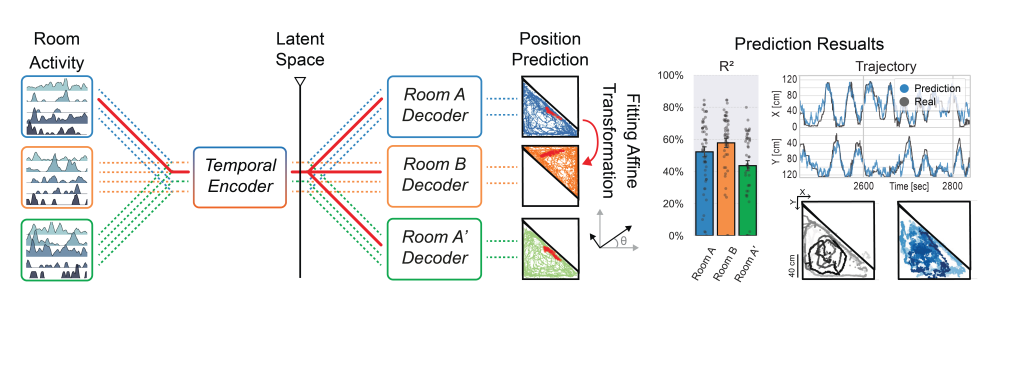
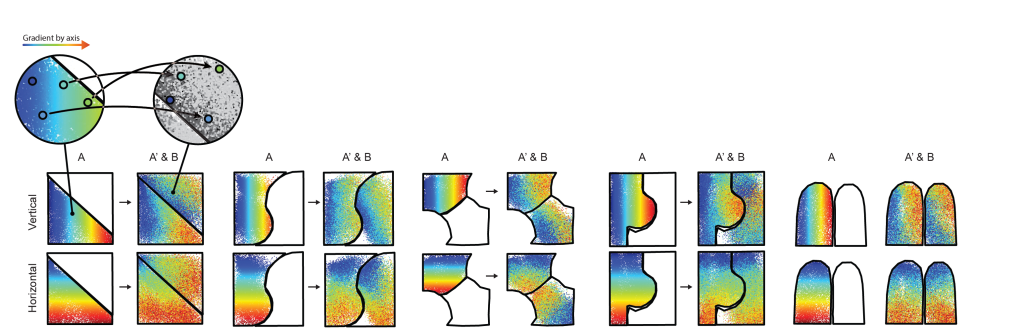
The remapping of spatial firing fields of cells in the hippocampal formation between rooms is a well-known and extensively studied phenomenon; however, the organizing principle for this remapping is unknown. While CA1 shows random remapping, regions such as the subiculum and medial entorhinal cortex (MEC) display a more organized transformation between rooms. Still, the structure of this transformation is unknown. To study this, we used high-density chronic Neuropixels recordings of the subiculum and MEC in freely moving mice and investigated the structure of the transformation at the population level. We implemented an advanced decoder to estimate the existence and characteristics of the remapping transformation. We deliberately designed the decoder as non-linear and time-dependent to capture rich and complex transformations. To our surprise, we discovered that the ensemble activity often underwent a simple, smooth, low-dimensional transformation captured by an affine transformation (i.e., rotation, scaling, and shear). The population code is thus flexibly adapted to a new context while retaining a stable spatial representation at the network level. This principle was reproduced across the subiculum and the MEC, as well as across spatial cell types such as border, head direction, and other spatially modulated cells. These results provide new insights into the computational principles of hippocampal formation remapping, suggesting that spatial cognition is subserved by adaptive ensemble codes governed by a simple affine coordinate transformation. Our findings establish population structure as a critical organizing principle for spatial memory, suggesting avenues for decoding spatial information in unvisited environments by embedding transformation rules into population-level decoders. We thus demonstrate for the first time a simple organizing principle for the representation of the transformation between diverse environments in the hippocampal formation.
(Preprint)